From John Helmiere, who works in the room next door to SPLAB in the Cultural Corner:
Hi Everyone,
I was beaten, arrested, and jailed by the Seattle Police Department yesterday as I sought to be a non-violent, peace-making presence at an event called West Coast Port Occupy. I didn’t participate with the intention of getting arrested and certainly didn’t anticipate the assault, but it happened, and I’d like to share the story as widely as I can. Please share with your networks, particularly anyone with platforms to spread the news. You may have read about Occupy actions in mainstream media sources, which are almost always told from the perspective (and thus with the spin) of the police. I want to offer you my story. It is attached as a PDF and pasted in this email below.
In Hope,
John

Yesterday evening, I was brutally beaten by my brothers on the Seattle Police force as I stood before an entrance to Pier 18 of the Seattle Port in my clergy garb bellowing, “Keep the Peace! Keep the Peace!” An officer pulled me down from behind and threw me to the asphalt. Between my cries of pain and shouts of “I’m a man of peace!” he pressed a knee to my spine and immobilized my arms behind my back, crushing me against the ground. With the right side of my face pressed to the street, he repeatedly punched the left side of my face for long enough that I had time to pray that the crunching sounds I heard were not damaging my brain. I was cuffed and pulled off the ground by a different officer who seemed genuinely appalled when he saw my face and clerical collar. He asked who I was and why I was here, to which I replied, “I’m a minister of the gospel of Jesus Christ, I believe another world is possible.” He led me shaking to a police van where began a 12-hour journey of incarcerated misery.
How did this happen?
The afternoon of Monday December 12 began with a march from downtown Seattle to the Port in a coordinated attempt by West Coast Occupy movements to expose exploitation of workers and interrupt business as usual at major Pacific ports. Upon arrival, the crowd spread out to picket or blockade entrances. I joined a small group of about 40 to picket a side entrance (we did not stop anyone from walking in or out). Several hours later, word came that business had been canceled for the day and our group dispersed in high spirits. My wife, Freddie, and I considered going home after a long, chilly day of standing up for what we believed in, but decided to see if there was an important need we might fill at other locations before departing.
As we neared a major entrance, Pier 18, the tension was almost palpable. Hundreds of people had been occupying the blockaded road for hours while police kept their distance. But night was falling, mounted officers arrived on the scene, and the police began to maneuver into position and adopt menacing expressions. Shortly before they pounced, I began to feel a great fear ballooning in my chest and seriously considered leaving. I sensed that the police would be ruthless under the cover of darkness. This fear was particularly strong because although my Christian convictions call me to non-violence, I had only practiced this by intervening in street fights, and never in the face of a militarized force that believes they can act with legal and social impunity. But in my spiritual core, the place where conscience prevails over fear and self-interest, I knew that I could not run away when the situation desperately called for disciplined non-violent voices and presence.
Utterly terrified, I made my way to the line between the occupiers and the police, held my arms out, and began shouting to my occupation brothers and sisters: “Peaceful Protest Everyone,” “Keep the Peace,” “Do not respond with violence.” My brothers and sisters on the police force began advancing behind a wall of horses and heavy bicycles. I linked arms with a young man in dark clothing on my left and a gnarled grandfather on my right. We stood still until the officers approached us and began throwing their bikes into our bodies, shoving us toward the sidewalk. I stared into the eyes of the most aggressive officer, who was seething, and shouted above the noise, “Why are you causing violence to peaceful people? Think about your actions! Think about your humanity!” With an open hand he rammed my throat. The old man to my left was attacked similarly and reached back with a cocked fist, but I yanked him back.
A minute later, an officer threw me to the ground and punched me numerous times. With hands cuffed behind my back, I was led into a police van and caged alone for a half hour. In the dim light and cramped space, I sang “This Little Light of Mine” and recited Psalm 23 to stave off a gnawing fear. Eventually, a few more occupiers joined me and we were transported to a holding facility where they split us into pairs and left us in tiny concrete rooms for several hours. The rooms were voids in every way: windowless, empty (no facilities, no benches), lit with glaring fluorescent bulbs, gray and white. My void-mate was a terrified kid who had gotten in over his head. He gave me heart by singing protest songs while I shared some meditation techniques for maintaining self-possession in trying moments. Eventually we were hauled off to the county jail and had our handcuffs removed after four long hours of immobility. As I walked through the metal detector at the jail, a fellow occupier I hadn’t spoken with yet looked at me in my collar and said, “You’ve just been baptized.” They outfitted us in thin cotton jail uniforms, and proceeded to move us from cell to freezing cold cell for the next eight hours without any clear purpose or explanation. During that time, the adrenaline wore off and my bruises and lacerations began aching intensely. I asked officers and staff at least six times to see a nurse and was consistently denied that, as well as water and food. During the final hour a nurse took pity on me and found an ice pack for my face. Not all the staff, it seemed, had contempt for their charges. Finally, at 5:00am we were released to the street after obligating ourselves to appear before a judge at a future date.
Why was I there in the first place?
First, I participated in the port occupation at the behest of some of the most exploited and underpaid laborers in our city—the men and women who truck containers in and out of the port. Over the past nine months, the spiritual community that I convene, Valley & Mountain, has stood in solidarity with these drayage workers in their struggle for dignity in the workplace. We have listened to the truckers’ stories, held a focused study of the issues, attended a Port Commissioners meeting to demand justice from elected officials, and participated in a major rally in support of the workers’ simple requests for access to bathrooms, less toxic trucks, and basic workplace protections (to learn more about their plight, read their open letter in support of the port occupation). I participated to stand alongside them.
Second, I participated because I have witnessed overwhelming evidence that the economic and political systems of my country stand against those people who the God I worship stands for. My conception of God, inadequate as it may be, is better described as the Love that generates creativity and community, than as a super-man judging us from a heavenly skybox. Such a God cannot be exclusively claimed by a political party, a religion, or even a movement like Occupy. Such a Love contrasts with everything that reserves power, dignity, wealth, and the status of full humanity for some while depriving it from others. My commitment to Love requires me to challenge the increasing consolidation of all these good things in the hands of a few, and to collaborate for the creation of something that Love would recognize as kin.
A call to transformation
Here is what I am asking of anyone who will hear it:
· Listen deeply.
· Get upset.
· Generate Love.
By listening deeply, I mean allowing the experiences of others to alter your own worldview. It might mean allowing my story to challenge assumptions you may have about the reliability of police discipline or mainstream media impartiality (reports of the activity by the Seattle Times, for example, are significantly skewed thus far). It may mean allowing the stories of exploited people, like the port truckers, to challenge your assumptions about the American narrative of equal opportunity. Whatever it means, it will require humility and proactive encounters with those you tend to avoid.
By getting upset, I mean being appalled at the dehumanizing forces operating in our world—forces unveiled by deep listening. Nothing changes just because you become aware that port truckers have to defecate in plastic bags because their unjust classification as “independent contractors” bars them from using the employee bathrooms. Nothing changes just because you know that some cities have police cultures that encourage brutality, particularly against people of color. We must have the tenderness of heart to become upset when human beings are violated and oppressed.
By generating love, I mean channeling that passion into creative and liberating action. There are so many excuses to avoid it: “The issues are so complex,” “There are two sides to everything,” “I don’t want to alienate anyone and lose a chance at making an impact later.” But as the great preacher/activist William Sloane Coffin once said, “Not taking sides is effectively to weigh in on the side of the stronger.” As finite creatures, we cannot fight every worthy battle. But refusing to participate in any struggle for a more loving world is a nihilistic rejection of even our very finite power. Right now I am praying for the courage to transform the molecules of my anger and the raw material of my frustration into the greatest, most indestructible, most transformative power on earth: unconditional love in action.
– John Helmiere

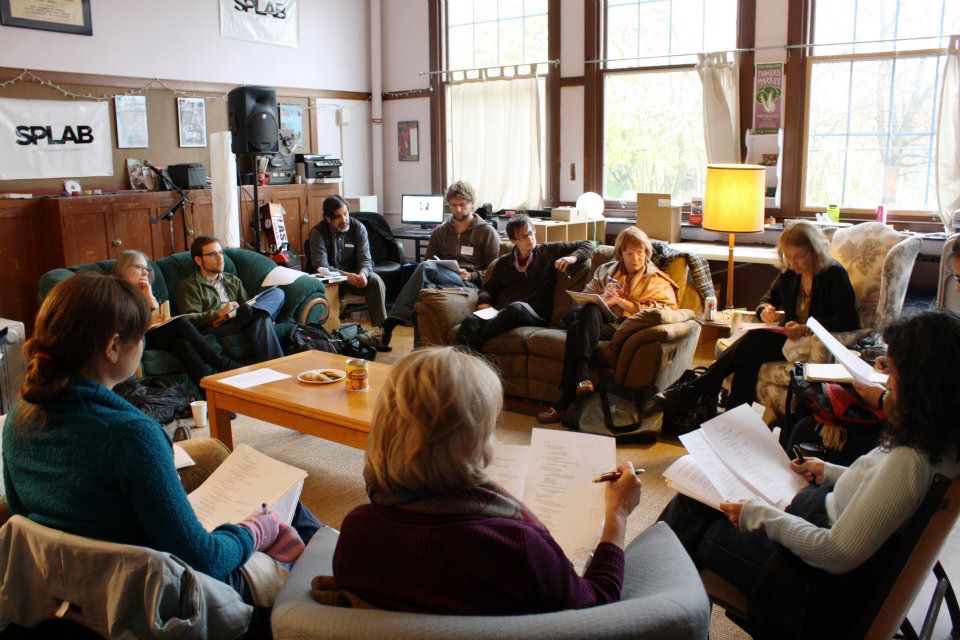 Writers of all ages and skill levels gather Tuesdays at 7P to read new work, the work of someone else or to just be in the engaging company of other writers. Your donation of $5 helps SPLAB continue our programming. Please bring 8 copies of the work you plan to read. If you do not bring copies, they are available for 10c.