Tuesday April 10 Living Room 7P Repetition 7P Living Room Tuesday April 10

The Strangeness of Repetition

Gertrude Stein

“It is very like a frog hopping he cannot ever hop exactly the same distance of the same way of hopping at every hop. A bird’s singing is perhaps the nearest thing to repetition but if you listen they too vary their insistence.”
—Gertrude Stein

Xerox Candy Bar
By Richard Brautigan

Ah,
you’re just a copy
of all the candy  bars
I’ve ever eaten.


selected from Makeup on Empty Space
by Anne Waldman

I am putting makeup on empty space
all patinas convening on empty space
rouge blushing on empty space
I am putting makeup on empty space
pasting eyelashes on empty space
painting the eyebrows of empty space
piling creams on empty space
painting the phenomenal world
I am hanging ornaments on empty space
gold clips, lacquer combs, plastic hairpins on empty space
I am sticking wire pins into empty space
I pour words over empty space, enthrall the empty space
packing, stuffing jamming empty space
spinning necklaces around empty space
Fancy this, imagine this: painting the phenomenal world
bangles on wrists
pendants hung on empty space
I am putting my memory into empty space


Nothing in That Drawer by Ron Padgett

Nothing in that drawer.

Repetition. Repetition. Repetition.  We all use it, and we all respond to it. In this workshop we will discuss and explore the function of repetition in poems. While there seems to be so many ways and purposes for repetition I hope that we will consider the strangeness of repetition. Some questions I might offer are: How does repetition affect words? What kinds or forms of repetition do we encounter and appeal to us? As poets how do we employ repetition and for what purposes? When does repetition succeed and when does it fail? What relationship does repetition have to the supernatural?—to the sacred?—to sound? In addition to considering what poets do with repetition I will offer a selection of writing exercises that centralize repetition and invite participants to bring in any exercise they have used successfully or unsuccessfully. Nadine Maestas is your guide. Bring $5 for the SPLAB hat.

Writers of all ages and skill levels gather Tuesdays at 7P to read new work, the work of someone else or to just be in the engaging company of other writers. Your donation of $5 helps SPLAB continue our programming. Please bring 8 copies of the work you plan to read. 

Living Room happens in the new SPLAB in the Cultural Corner of the old Columbia School, between Rainier AV S and 36th AV S, on Edmunds. We’re 2 blocks from the Columbia City Link Light Rail Station. (Parking is available on the school grounds.)

For the 2011-2012 SPLAB Schedule, click here. (Events subject to change. All events Living Room unless otherwise noted.)

Posted in Blog | Tagged , , , , , , , | Leave a comment

Cascadia Poetry Fest Poster/Summaries

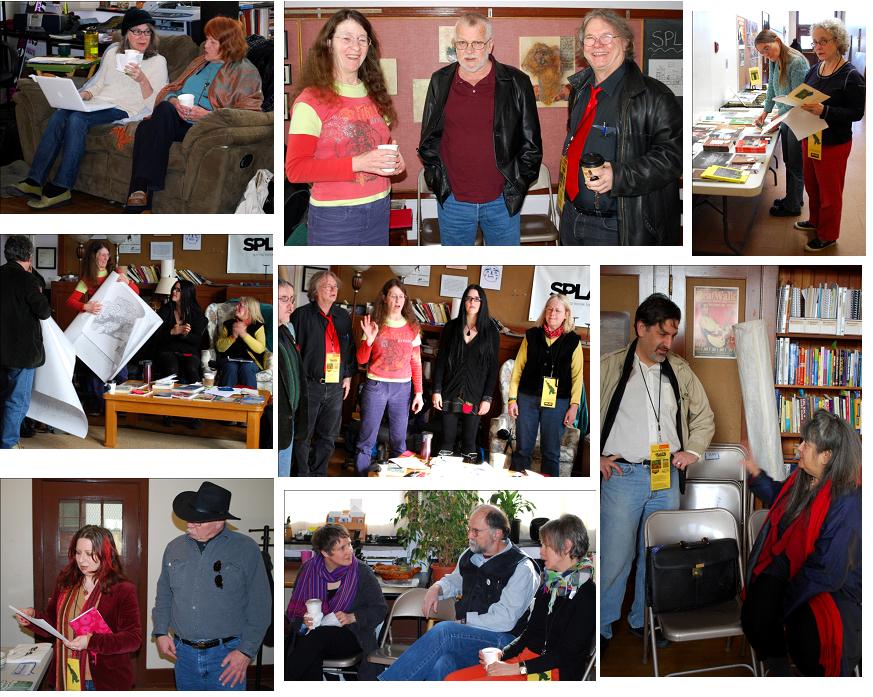
Here are links to some of the photographs and summaries of the 1st Cascadia Poetry Festival:

Barbara Erwine photos: https://skydrive.live.com/?cid=2a6e06a3285ad19c&Bsrc=SkyMail&Bpub=SDX.SkyDrive&sc=Photos&id=2A6E06A3285AD19C!200

Kim Goldberg’s blog post: http://pigsquash.wordpress.com/2012/03/31/cascadia-poetry-festival-photos/

Four Hoarse Men video: http://gregbem.com/wordpress/vid-4-hoarse-men-read-at-puget-sound-poetry/

Great Beer and Poetry photos: http://gregbem.com/wordpress/pics-3-24-12-great-beer-and-poetry-the-reading/

Keynote Reading: http://gregbem.com/wordpress/pics-3-25-12-cascadia-poetry-festival-day-2-pt-1-workshop/

Day One Roundtable Discussion: http://gregbem.com/wordpress/pics-cascadia-poetry-festival/

Seward Park Eco-Poetry panel: http://www.flickr.com//photos/78357609@N07/sets/72157629305384242/show/

Sam Hamill closing reading: https://picasaweb.google.com/101978652846587794634/032512SamHamilReadsAtSPLAB?authuser=0&feat=directlink

Cascadia Open Mic: https://picasaweb.google.com/101978652846587794634/032512CascadiaFestivalOpenMicAtSPLAB?authuser=0&feat=directlink

Some Images from the 1st Cascadia Poetry Festival, Barbara Erwine, photographer

Posted in Blog | Tagged , , , , , , , , , , , , , , , , | Leave a comment

Living Room April 3, 7P – Synesthesia


Synesthesia

Synesthesia is a neurologically based condition in which stimulation of one sensory or cognitive pathway leads to automatic and involuntary experiences in a second sensory or cognitive pathway.  We are not talking about constructing clever metaphors here, for these “afflicted” the effect is automatic and consistent (and not deliberate, delusional or the result of schizophrenia).   One common form of synethesia is visual motion to sound synesthesia.  This involves sounds being heard in response to visual motions or flickers. Another form is Grapheme to color synesthesia during which letters and numbers are perceived to be inherently colored.  Interestingly, synthestes from different cultures note similar colors inherent in certain numbers; for example, the numbers 3, 6 and 9 are often generated from and seen the warm and hot red spectrum.  2, 4 and 8 are often formed from cooler, blue ranges.

Tuesday night facilitator Joe Chiveney and participants will be exploring a condition called Ordinal Linguistic Personification. This is a form of synesthesia where for those “afflicted,” numbers, days of the week and months are associated with inherent personalities. Here are some examples from an 1893 study:

“T’s are generally crabbed, ungenerous creatures. U is a soulless sort of thing. 4 is honest, but… 3 I cannot trust… 9 is dark, a gentleman, tall and graceful, but politic under his suavity.”

Another subject from the same 1893 study noted that:

“I [is] a bit of a worrier at times, although easy-going; J [is] male; appearing jocular, but with strength of character; K [is] female; quiet, responsible….” February is “an introverted female”, while F is a “[male] dodgy geezer”. Similarly, May is reported to be “soft-spoken” and “girly” while M is an “old lady [who] natter[s] a lot”, and while August is “a boy among girls”, A is a female “mother type”

And another from the same 1893 study:

“1, 2, 3 are children without fixed personalities; they play together. 4 is a good peaceful woman, absorbed by down-to-earth occupations and who takes pleasure in them. 5 is a young man, ordinary and common in his tastes and appearance, but extravagant and self-centered. 6 is a young man of 16 or 17, very well brought up, polite, gentle, agreeable in appearance, and with upstanding tastes; average intelligence; orphan. 7 is a bad sort, although brought up well; spiritual, extravagant, gay, likeable; capable of very good actions on occasion; very generous. 8 is a very dignified lady, who acts appropriately, and who is linked with 7 and has much influence on him. She is the wife of 9. 9 is the husband of Mme. 8. He is self-centred, maniacal, selfish, thinks only about himself, is grumpy, endlessly reproaching his wife for one thing or another; telling her, for example, that he would have been better to have married a 9, since between them they would have made 18 – as opposed to only 17 with her… 10, and the other remaining numerals, have no personifications”.


Tuesday night we will explore our inner synesthete with a writing exercise designed to invoke us involuntary, activate us automatically while simultaneously and soberly scrambling what senses we thought we had.  Bring your egg whisks, pen and paper and be willing to question some seemingly common words about their hidden personas.

Writers of all ages, backgrounds and skill levels gather Tuesdays at 7P to read new work, the work of someone else or to just be in the engaging company of other writers. Your donation of $5 helps SPLAB continue our programming. Please bring 8 copies of the work you plan to read. Copies are no longer provided by SPLAB.

Living Room happens @ SPLAB in the Cultural Corner at 3651 S. Edmunds. (Look for the SPLAB sign on the wall and come inside.) We’re 2 blocks from the Columbia City Link Light Rail Station. (Parking is available on the school grounds.)

Posted in Blog | Tagged , , , , , | Leave a comment

Cascadia Afterthoughts 3.27.12 Living Room

We’re still recovering from the very successful Cascadia Poetry Festival which SPLAB conceived of and hosted this past weekend. This week in the Living Room we’ll share our best memories of the just-concluded fest, discuss plans for future iterations and leave plenty of time for critique of your new work. Paul Nelson pinch hits for his wife Meredith who is busy with 9 day old Ella Roque Nelson. He’ll discuss his thoughts about innovative Cascadia poetry and Robert Duncan’s distinction between poetry as an event or as the record of an event.

Writers of all ages, backgrounds and skill levels gather Tuesdays at 7P to read new work, the work of someone else or to just be in the engaging company of other writers. Your donation of $5 helps SPLAB continue our programming. Please bring 8 copies of the work you plan to read. Copies are no longer provided by SPLAB.

Living Room happens @ SPLAB in the Cultural Corner at 3651 S. Edmunds. (Look for the SPLAB sign on the wall and come inside.) We’re 2 blocks from the Columbia City Link Light Rail Station. (Parking is available on the school grounds.)

Ella & Meredith

Notes on Poem as Event or as Record of Event (SPLAB Living Room, March 27, 2012)

Jiddu Krishnamurti – To meditate implies seeing very clearly and it is not possible to see clearly, or be totally involved in what is seen, when there is a space between the observer and the thing observed. That is, when you see a flower, the beauty of a face, or the lovely sky of an evening, or a bird on the wing, there is space – not only physically but psychologically – between you and the flower, between you and the cloud which is full of light and glory; there is space – psychologically.

When there is that space, there is conflict, and that space is made by thought, which is the observer. Have you ever looked at a flower without space? Have you ever observed something very beautiful without the space between the observer and the thing observed, between you and the flower? We look at a flower through a screen of words, through the screen of thought, of like and dislike, wishing that flower were in our own garden, or saying “What a beautiful thing it is”.

In that observation, whilst you look, there is the division created by the word, by your feeling of liking, of pleasure, and so there is an inward division between you and the flower and there is no acute perception. But when there is no space, then you see the flower as you have never seen it before.

When there is no thought, when there is no botanical information about that flower, when there is no like or dislike but only complete attention, then you will see that the space disappears and therefore you will be in complete relationship with that flower, with that bird on the wing, with the cloud, or with that face.
From Charles Olson, Projective Verse http://www.globalvoicesradio.org/Projective_Verse.html

First, some simplicities that a man learns, if he works in OPEN, or what can also be called COMPOSITION BY FIELD, as opposed to inherited line, stanza, over-all form, what is the “old” base of the non-projective.

(1) the kinetics of the thing. A poem is energy transferred from where the poet got it (he will have some several causations), by way of the poem itself to, all the way over to, the reader. Okay. Then the poem itself must, at all points, be a high energy-construct and, at all points, an energy-discharge. So: how is the poet to accomplish same energy, how is he, what is the process by which a poet gets in, at all points energy at least the equivalent of the energy which propelled him in the first place, yet an energy which is peculiar to verse alone and which will be, obviously, also different from the energy which the reader, because he is a third term, will take away.

This is the problem which any poet who departs from closed form is specially confronted by. And it involves a whole series of new recognitions. From the moment he ventures into FIELD COMPOSITION— put himself in the open— he can go by no track other than the one the poem under hand declares, for itself. Thus he has to behave, and be, instant by instant, aware of some several forces just now beginning to be examined. (It is much more, for example, this push, than simply such a one as Pound put, so wisely, to get us started: “the musical phrase,” go by it, boys, rather than by, the metronome.)

(2) is the principle, the law which presides conspicuously over the composition, and, when obeyed, is the reason why a projective poem can come into being. It is this: FORM IS NEVER MORE THAN AN EXTENSION OF CONTENT. (Or so it got phrased by one, R. Creeley, and it makes absolute sense to me… (tho Levertov suggested FORM IS NEVER MORE THAN A REVELATION OF CONTENT,which seems more accurate, Ed).

Now (3) the process of the thing, how the principle can be made so to shape the energies that the form is accomplished. And I think it can be boiled down to one statement (first pounded into my head by Edward Dahlberg): ONE PERCEPTION MUST IMMEDIATELY AND DIRECTLY LEAD TO A FURTHER PERCEPTION. It means exactly what it says, is a matter of, at all points (even, I should say, of our management of daily reality as of the daily work) get on with it, keep moving, keep in, speed, the nerves, their speed, the perceptions, theirs, the acts, the split second acts, the whole business, keep it moving as fast as you can, citizen. And if you also set up as a poet, USE USE USE the process at all points, in any given poem always, always one perception must must must MOVE, INSTANTER, ON ANOTHER! So there we are, fast, there’s the dogma. And its excuse, its usableness, in practice. Which gets us, it ought to get us, inside the machinery, now, 1950, of how projective verse is made…

And the threshing floor for the dance? Is it anything but the LINE? And when the line has, is, a deadness, is it not a heart which has gone lazy, is it not, suddenly, slow things, similes, say, adjectives, or such, that we are bored by? For there is a whole flock of rhetorical devices which have now to be brought under a new bead, now that we sight with the line. Simile is only one bird who comes down, too easily. The descriptive functions generally have to be watched, every second, in projective verse, because of their easiness, and thus their drain on the energy which composition by field allows into a poem. Any slackness takes off attention, that crucial thing, from the job in hand, from the push of the line under hand at the moment, under the reader’s eye, in his moment. Observation of any kind is, like argument in prose, properly previous to the act of the poem, and, if allowed in, must be so juxtaposed, apposed, set in, that it does not, for an instant, sap the going energy of the content toward its form…

Robert Duncan from Bending The Bow

Roethke from North American Sequence

Posted in Blog | Tagged , , , , , , , , , , , , | Leave a comment