The Cascadia Poetry Festival is an international event which seeks to bioregionally animate & culturally construct Cascadia by gathering writers, artists, scientists and activists to collaborate, discover and foster deeper connection between all inhabitants and the place itself.
The second Cascadia Poetry Festival is scheduled for May 2-4, 2014, at Seattle University. Details are forthcoming. Information on Cascadia I (2012) is here.
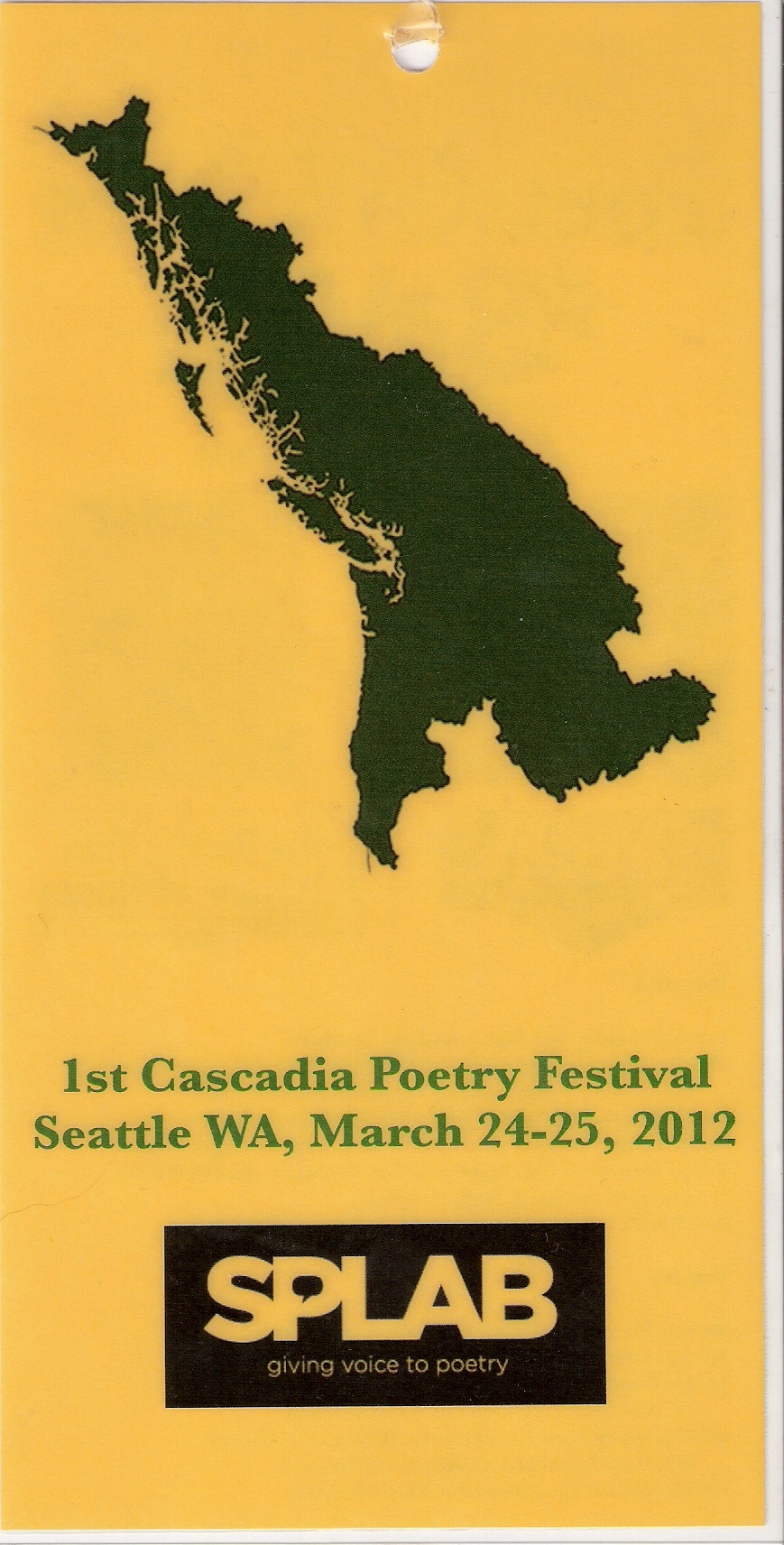
Gold Pass from Cascadia I
(Map: David McCloskey © 2010, Cascadia Institute )
The Cascadia Poetry Festival Advisory Board is listed here.
David McCloskey of the Cascadia Institute is a Consulting Faculty Member.
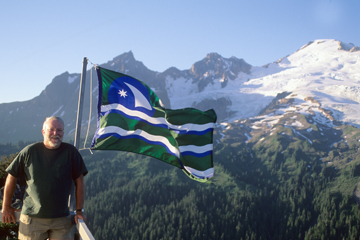
David McCloskey
David McCloskey is a long-time bioregionalist. He taught Sociology, Ecology, and Geography
at Seattle University for many years. Known as “the Father of Cascadia,” he has spoken,
organized, and written widely on Cascadia & the Bioregional Vision. He made the first maps
of “Cascadia” & “The Ecoregions of Cascadia,” and is currently working on “The Bioregions
of Western North America.”
In search of the spirit of place, he has also compiled an anthology of
Cascadian Poetry in 4 movements: “Mountains, Rivers, Sea, and Sky.”
He retired in 2004, and moved back home to Eugene to remodel
the family homestead, and run the Cascadia Institute.




From Bill Yake:
Hi Paul,
The idea of examining poetry from the perspective the Cascadia bioregion is an intriguing one. I guess a couple of thoughts come to mind:
For instance, it’s my understanding that the concept of cultures (or maybe, more accurately, cultural families) growing out of the waters and soils of a bioregion seems to be rooted in the work of North American ethnologists, especially Alfred Kroeber (father of Ursula LeGuin). Something similar to current concepts of Cascadia may have first appeared in Kroeber’s book, Cultural and Natural Areas of Native North America (1947) as a cultural region he calls “The Northwest Coast”: cultures ranging from the Tlingit of southern Alaska to the Yurok, Karok and Hupa of the lower Klamath River drainage of northwestern California. These cultures grew out of settings that provided similar foods (including salmon and other sources of marine fat and protein) and natural materials: mussel shell knives, a similar range of forest materials including cedar, medicines, berries.
Gary Snyder elaborated on this concept in his essay “The Place, The Region, and the Commons” in The Practice of the Wild. First he looks at the “regional outline” defined by the range of the Douglas Fir — “the definitive tree of the Pacific Northwest.” This outline, he says, has its “northern limit…around the Skeena River in British Columbia. It is found west of the [Cascade] crest through Washington, Oregon, and northern California. The southern coastal limit of Douglas Fir is about the same as that of salmon, which do not run south of the Big Sur River … [This] outline describes the boundary of a larger natural region that runs across three states and one international border.”
Later in the essay he implies that this larger “regional outline”, which he doesn’t name, might be divided into three bioregions: The Shasta bioregion to the south, the Cascadia/Columbia region north of this, and finally the Ish River country – the drainages to Puget Sound and Straits of Georgia, what we now call the Salish Sea. The latter would include home territories for this conference and some of those listed here as key participants: Seattle, Vancouver, the San Juan and Gulf Islands, the Olympic Peninsula, Anacortes, etc.
Other riffs on the concept include those by Bates McKee in his Cascadia: the Geologic Evolution of the Pacific Northwest (1972) and David McCloskey, a Seattle University bioregionalist, in an essay entitled “On Ecoregional Boundaries” (1993).
Author and lepidopterist Bob Pyle uses this definition in The Butterflies of Cascadia: “… a conservative definition of the bioregion known as Cascadia – all of Washington and Oregon, and the bordering sections of southern British Columbia, western Idaho, and northernmost California and Nevada.”
Somehow, it seems this history of thought and consideration could be profitably wound into seminar planning.
A second, related, thought is that a [the?] key concept behind bioregionalism is the value of becoming native in the place one lives. That can mean different things to different folks, but it seems that it certainly ought to include the cultural perspective of Cascadia native people.
I just came across this relevant and astute passage from Robert Bringhurst – a great Canadian thinker, poet, and student of native literature (especially that of the Haida).
“Accepting and absorbing native North American [art and literature] means refocusing our sense of history, letting go of the view that ‘we are all immigrants here” and moving towards a condition in which all of us are natives. It means erasing the false boundary between “native art” and “high art.” It means pooling the contents of art museums and ethnographic collections, then shaking down the result on the basis of quality instead of cultural origin… [T]hese are good and healthy principles, every bit as applicable in the literary realm as in the domain of visual art.”
This perspective was based on Bringhurst’s in depth discussions with his friend, the preeminent Haida sculptor, Bill Reid.
The inclusion of the perspective of native literature – especially the works of classic myth tellers – might well be essential to a meaningful discussion of Cascadian poetics.
All the best to all involved,
Bill
Another note from Bill Yake:
Paul,
Finally chased down a lead that might be useful for the conference. Especially as a means of beginning the process of becoming aware, and thus more native to this place. Also as a prompt for poetry and other writing. It’s a series of questions, the first version of which was apparently were initially published in The Whole Earth Catalogue (http://connectedbynature.com/2010/01/happy-2010-where-you-at-a-bioregional-quiz/) :
30 questions to elevate your awareness (and literacy) of the greater place in which you live:
1) Point north.
2) What time is sunset today?
3) Trace the water you drink from rainfall to your tap.
4) When you flush, where do the solids go? What happens to the waste water?
5) How many feet above sea level are you?
6) What spring wildflower is consistently among the first to bloom here?
7) How far do you have to travel before you reach a different watershed? Can you draw the boundaries of yours?
8 ) Is the soil under your feet, more clay, sand, rock or silt?
9) Before your tribe lived here, what did the previous inhabitants eat and how did they sustain themselves?
10) Name five native edible plants in your neighborhood and the season(s) they are available.
11) From what direction do storms generally come?
12) Where does your garbage go?
13) How many people live in your watershed?
14) Who uses the paper/plastic you recycle from your neighborhood?
15) Point to where the sun sets on the equinox. How about sunrise on the summer solstice?
16) Where is the nearest earthquake fault? When did it last move?
17) Right here, how deep do you have to drill before you reach water?
18) Which (if any) geological features in your watershed are, or were, especially respected by your community, or considered sacred, now or in the past?
19) How many days is the growing season here (from frost to frost)?
20) Name five birds that live here. Which are migratory and which stay put?
21) What was the total rainfall here last year?
22) Where does the pollution in your air come from?
23) If you live near the ocean, when is high tide today?
24) What primary geological processes or events shaped the land here?
25) Name three wild species that were not found here 500 years ago. Name one exotic species that has appeared in the last 5 years.
26) What minerals are found in the ground here that are (or were) economically valuable?
27) Where does your electric power come from and how is it generated?
28) After the rain runs off your roof, where does it go?
29) Where is the nearest wilderness? When was the last time a fire burned through it?
30) How many days till the moon is full?
The Bigger Here Bonus Questions:
31) What species once found here are known to have gone extinct?
32) What other cities or landscape features on the planet share your latitude?
33) What was the dominant land cover plant here 10,000 years ago?
34) Name two places on different continents that have similar sunshine/rainfall/wind and temperature patterns to here.
Bill
Paul:
What are some Cascadian Poems?
Well, let’s see: you know, of course, Lew Welch’s “Shasta” & “Ring of Bone,” don’t you?
Then, among many others, there’s Sam Hamill’s exquisitely evocative perfectly pitched quiet poem, “On Orca Sound”–you know & love that one, right?
There are thousands of poems which can be clustered under many possible thematic headings, including some beautiful “Love,” “Leavings,” “Work,” poems, but really the topics and modes of presentation are endless.
Within the genre of so-called Nature poems, and within the orbit solely of poems which sing Rivers, for instance, you know, of course:
Mary Barnard’s “The Rapids,”
David Wagoner’s “Three Ways of a River,”
Ray Carver’s “Where Water Comes Together with Other Water,”
Wagoner’s “Trying to Sing in the Rain,”
Gary Snyder, “We Wash Our Bowls in the River,”
Wm Stafford’s “At the Metolius River,”
Harald Wyndam’s ” Entering the Water,”
Lawson Inada’s “Headwaters,”
Pat Lowther’s “Cataract,”
Jarold Ramsey’s, ” Desire at Craig Lake,”
Patricia Goedicke, “The Lake Itself,”
Tim McNulty, “Ka’houk,” to mention only a few;
of course, there are many other wonderful ones:
Hugo’s river poems, ones by Roger Dunsmore, Charles Lillard,
Patrick Lane, George Woodcock, Greg Keeler, Tom Pier’s fine fishing poems,
Sandra Alcosser, so many more by Ray Carver, Tom Wayman, Sherman Alexie, Mike O’Connor,
Tom Jay, Tim Bowling, Zoe Landale, Neile Graham, Joan Swift, Christiane Balk, Robert Sund, Theresa Kishkan, and many, many others….
Yours, David McCloskey
Cascadia Institute
I’m from the south of England and have always had a thing about the Pacific northwest, so much so that I left the UK five years ago and now live in Whitehorse, Yukon. I imagine drawing the Pacific northwest region on a sheet of tracing paper and placing it over Cascadia. It doesn’t fit but the overlap is intriguing, which is why I’m planning to attend the festival in March.
Pingback: putting poetry on the map… « Sue Boynton Poetry Contest
Hello Paul,
I’d like to participate in the Cascadia Poetry Festival, perhaps as a dialogue facilitator/poet. I feel as though I stand with my college students on a high diving board, filled with our questions about the future of this place, the larger region, its connections to the larger world. Can we meet?
Denise
Denise,
I’d love to meet. We need signups more than anything else. Call: 206.422.5002
Pingback: Schedule and Rates for Cascadia Poetry Festival March 24-25, 2012 | SPLAB
Pingback: Cascadia Poetry Festival coming to Seattle | Pig Squash Press
Pingback: Igniting the Green Fuse – Eco-Poetry Workshop in Seattle | Pig Squash Press
Pingback: Living Room February 7, 2012, 7pm: Free Association | SPLAB
Pingback: Puget SOUND Poetry | SPLAB
Pingback: Upcoming Event: Seattle’s Cascadia Poetry Festival » Greg Bem's Stale Attitude
Pingback: Washington State Poetry Questionnaire (From the new Poet Laureate) | SPLAB
Pingback: Great Beer and Poetry: The Cascadia After Party | SPLAB
What a fantastic event! If I had the $, I would consider attending.
The question I have: It is apparently assumed that there IS
a unique culture for the Cascadia Region that WILL show up in poetry and other writings… (rather than a west coast cultures, or ” we are the 99% cultures” and, or something else might show.).
I would start the exploration and examination (explication?) with the assuming question – I would also look for the kinds of social issues that are predominating, as well as absent from people’s writing now.
I hope someone will report-out about the findings of the conference? Appreciate that it is taking place in any instance.
L.E. author of the highly indie book, “Mural Poems: Human Rights and Antiwar Poetry” (2007), Plateau Sigma Press, Seattle. Available in a few libraries [finally]… .
Larry,
For my take on Cascadia Poetry Culture, see http://paulenelson.com/2012/03/13/cascadia-poetry-interview/
We do need volunteers. Would you be interested in helping with a couple of shifts at the door? Please let me know.
Thanks for your kind words about the fest.
Paul
Pingback: Tim McNulty Workshop Description: Images as Windows | SPLAB
Pingback: Cascadia Poetry Festival Update | SPLAB
Pingback: Igniting the Green Fuse: Women on Eco-poetry | SPLAB
I would certainly value helping/volunteering at the Festival – I will follow up about doing so. Appreciated. Larry.
Pingback: Coldfront » Seattle: A Tale of Two Festivals
Pingback: Pics: Cascadia Poetry Festival » Greg Bem's Stale Attitude
Pingback: Poetry:Read More, Blog More – Poetry Out Loud | Page247
Pingback: Eco-Poetry Chapbook Launched | Pig Squash Press
Pingback: Poetry in the Balance | Pig Squash Press
Pingback: Cascadia Poetry Festival – Photos | Pig Squash Press
Pingback: Palmlit.org Site Outline | UW Digital Publishing
Pingback: Bioregionalism & Ecopoetry • The Capilano Review